When you come to see a skin practitioner like me, you’re not just coming for a treatment.
You’re placing trust in the person in front of you to understand your skin, to assess it carefully, and to guide you safely.
That is something I take incredibly seriously.
Working with skin blemishes regularly, I constantly observe, compare, and assess what I see. No two blemishes are ever the same, and even the most common blemishes can present differently from one person to another. This is why ongoing training is not optional in my field, it is essential.
Over the years, I’ve invested in advanced education, both within the advanced cosmetic industry and alongside medical professionals, GPs, and dermatology specialists. My aim has always been simple: to deepen my understanding so I can look at the skin with greater accuracy, awareness, and care.
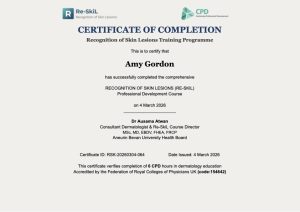
Most recently, I attended the Recognition of Skin Lesions (Re-SkiL) course, led by Osama Atwan. This course was mainly designed for GPs, focusing on dermatoscopy, the use of specialist tools and techniques to examine the skin more closely.
The training explored how to recognise different types of lesions, including common benign conditions such as moles, seborrhoeic keratosis, and solar lentigo, as well as how to identify patterns that may require further medical investigation.
We looked in detail at how features within the skin appear under magnification, such as pigment networks, globules, and structural changes, that can indicate whether something is stable or needs closer monitoring. The course also focused on real case studies, helping build confidence in understanding when a lesion is likely harmless and when, and if, I see something like this, I might advise seeking GP advice.
It’s important to say that I do not diagnose skin cancer, and this training is not about stepping into a medical role for me. What it does do is strengthen my ability to remain vigilant.
Because that is a key part of what I do.
I see skin up close, regularly, and over time. I often notice subtle changes that clients themselves may not have seen, or that may not have been present before. When something doesn’t look quite right, my role is to pause, to question, and to guide you towards the right next step, whether that is monitoring or seeking further medical advice.
I am also very fortunate to work closely with Dr Toby Nelson from Map My Mole, who supports practitioners in reviewing any lesions of concern. Having that direct link ensures that anything questionable can be checked quickly and appropriately, giving both my clients and me an added level of reassurance.
This combination of hands-on experience, continuous training, and collaboration with medical professionals enables me to deliver every treatment with confidence and care.
For you as a client, this means you are not just receiving a treatment. You are being seen by someone who is constantly learning, constantly refining their knowledge, and always prioritising your safety. Because working with skin is never just about what is visible. It’s about what is noticed, understood, and acted on.