
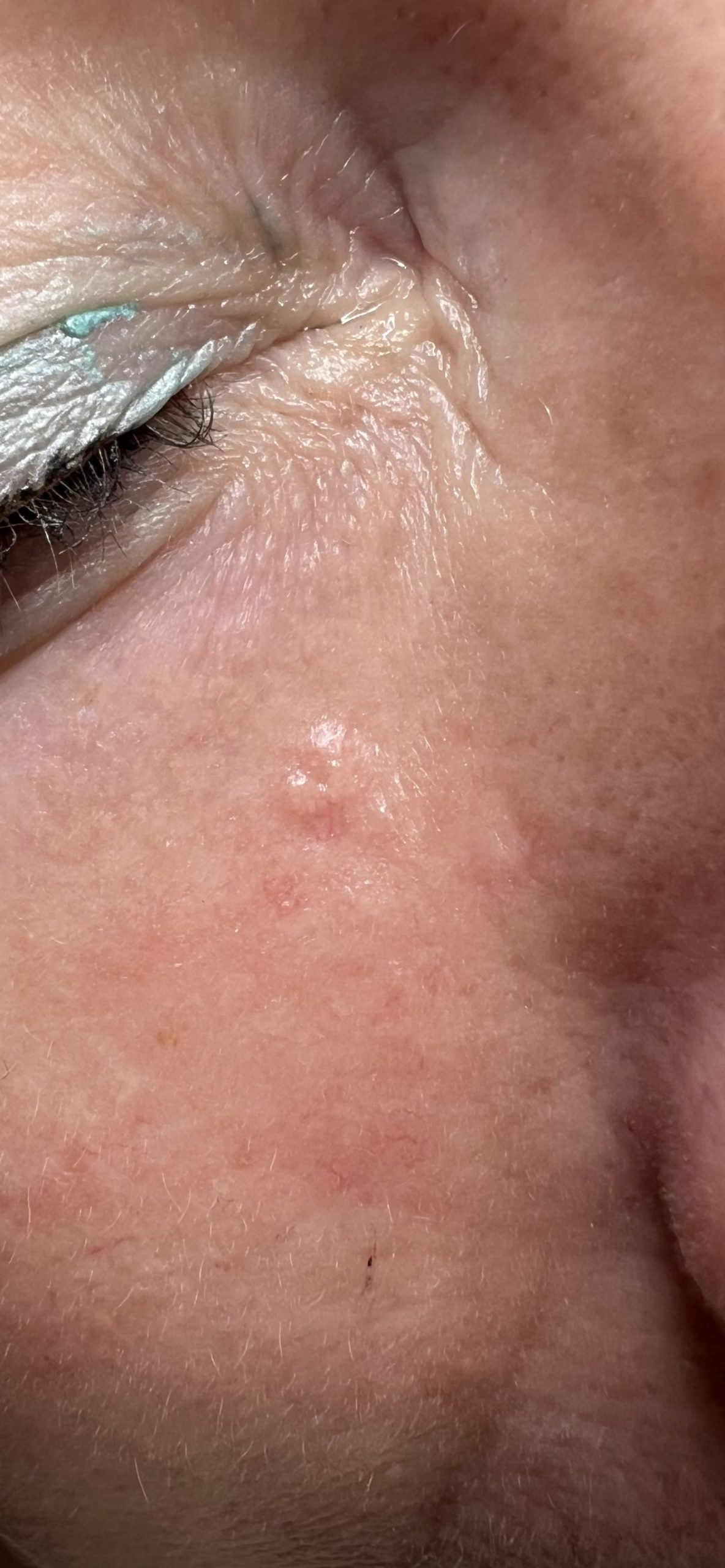
This blemish, Sebaceous Hyperplasia, is the one I am asked most about in terms of why am I getting it? How could I have avoided it? And is there anything I can do to stop it coming back? So I’ll delve a little more into it below.
Firstly, I would like to say that this blemish, particularly when found alone, is one I need to look out for and proceed with caution. It can look very similar to BCC (Basal Cell Carcinoma), so if I am ever in any doubt, I will always ask you to see your GP for a second opinion and/or use my dermatology process, which allows me to create a report and send it directly to a dermatologist to review and advise within 48 hours.
In general though it is a benign skin condition that occurs when the sebaceous glands which are oil glands become enlarged. It typically presents as a small, soft, yellowish or skin-coloured bump and commonly appears on the forehead and cheeks. As I have discussed above, while they are usually harmless, these blemishes can be mistaken Sebaceous Hyperplasia but are indeed BCC which is why a thorough assessment is so important.
The condition is most commonly seen in adults over 30 and is often associated with oily skin. Hormonal changes, genetics, sun exposure, and ageing all contribute to its development. As skin ages, cell turnover slows, and oil glands can become trapped beneath the surface, therefore leading to the condition.
Although sebaceous hyperplasia does not pose a medical risk of any kind, many clients choose to have it reduced or removed for cosmetic reasons. It can prove hard to cover with make-up and if not covered can deem to be unsightly by some. Skincare products may certainly be able to help manage oil production, but I am yet to see them remove established blemishes of this kind. Professional treatments are typically required for effective results such as what I offer which is advanced electrolysis, also know as electrocautery.
Treatment must be carried out by a trained, insured, and licensed practitioner who follows strict hygiene and sterilisation protocols. Proper technique and aftercare are vital to reduce the risk of infection or scarring.
With expert assessment and appropriate care, sebaceous hyperplasia can be managed effectively, helping to restore smoother skin.