
If you’ve been noticing more skin tags on your neck than you used to, small red dots appearing on your torso, a scattering of little bumps around your jawline, or brown patches that never used to be there, you’re not imagining it, and you’re definitely not alone. I see many clients in their 40s and 50s who feel their skin has changed on them, and it’s genuinely one of the most common conversations I have.
The reason is hormonal. As oestrogen levels start to fluctuate in perimenopause and then drop away in menopause, your skin loses collagen, becomes thinner, and behaves differently at almost every level. That drop influences pigment production, blood vessel fragility, and the way your skin renews itself, which means the blemishes I treat tend to appear more often and become more visible from your late 30s onwards.
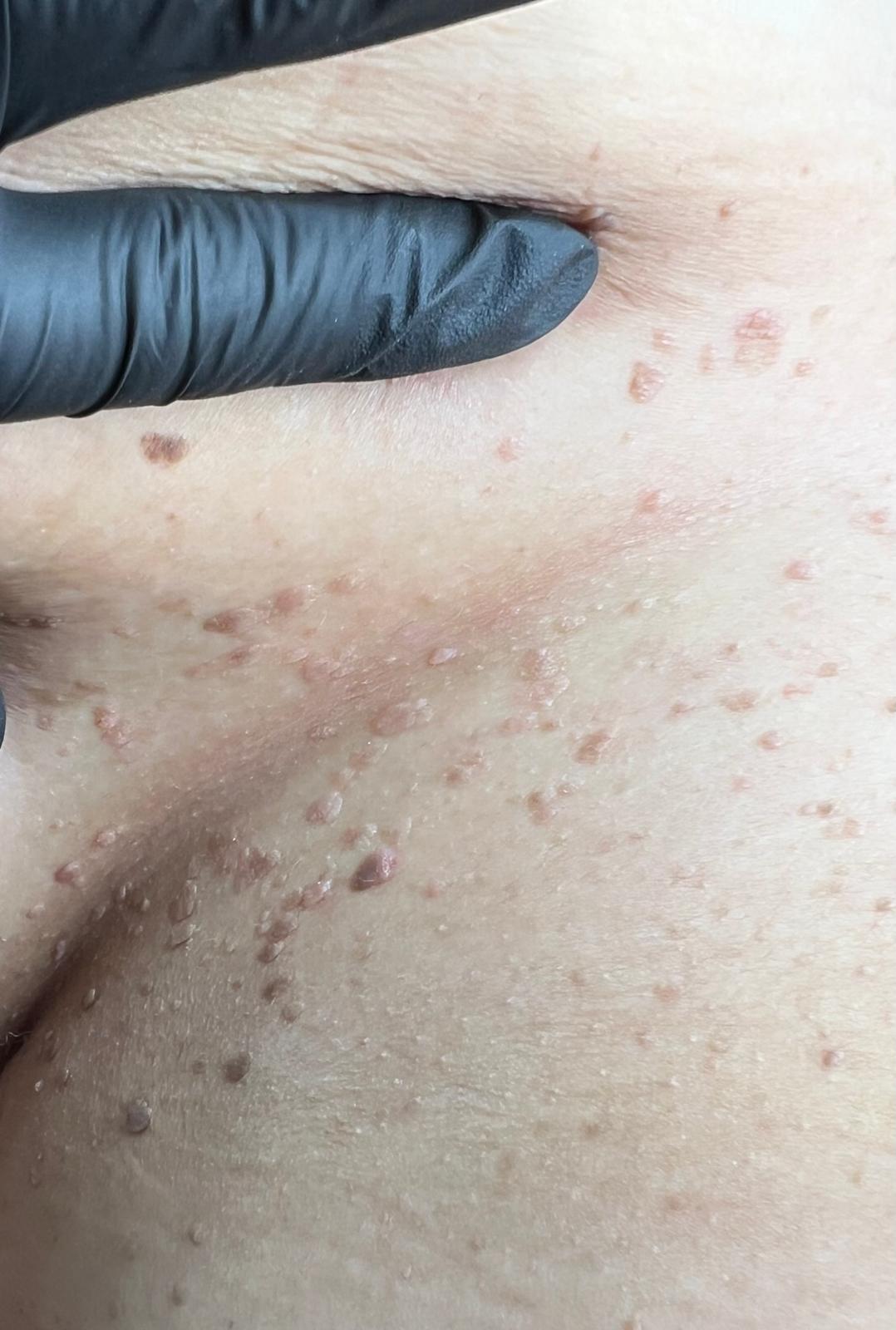
Skin tags are the clearest example. Many women barely have any until their 40s and then suddenly notice a small crop appearing along the neck, under the bra line, in the armpits, or on the eyelids. Hormonal shifts are one of the biggest triggers, alongside genetics and friction. They’re completely harmless, but they can catch on necklaces, drive you mad in the mirror, and quietly chip away at your confidence.
Cherry angiomas, which are those tiny, bright red spots that seem to appear from nowhere on the chest, back or stomach, also become more common in this stage of life. They’re clusters of small blood vessels that form as capillary fragility increases, and they’re one of the most satisfying blemishes to treat because the result is immediate.
Sebaceous hyperplasia, the small yellowish or flesh-coloured bumps that often appear on the forehead, cheeks and along the jawline, is another one I see much more of in perimenopausal skin. It happens as oil glands enlarge and become more visible through thinning skin, and it can be mistaken for milia, small blemishes or even acne. It responds beautifully to advanced electrolysis.
Then there are thread veins on the cheeks and around the nose, more prominent seborrheic keratoses (those “stuck-on” brown patches your grandmother might have called liver spots), and sun damage that has been quietly accumulating for years suddenly becoming visible as skin thins. All of these are treatable with the work I do. Although some pigments I may suggest alternative treatment is better.
With all that said, it is important for me to mention that any mole changes deserve a slightly different kind of attention. Hormonal shifts can affect existing moles, making them appear darker, larger or slightly altered, and while most changes are completely benign, this is exactly when getting your moles properly checked matters most. My Map My Mole service, where images are reviewed by a consultant dermatologist and a report is sent back in around 72 hours, is designed for exactly this reassurance.
If perimenopause has changed your skin, please know that so much of what you’re seeing is treatable. Skin tags, cherry angiomas, sebaceous hyperplasia, thread veins, xanthelasma and more can all be gently and precisely removed, and the difference it makes to how women feel about themselves is honestly one of the best parts of my job.
To book your consultation in either my Colchester, Chelmsford or Clapham Clinic CLICK HERE