
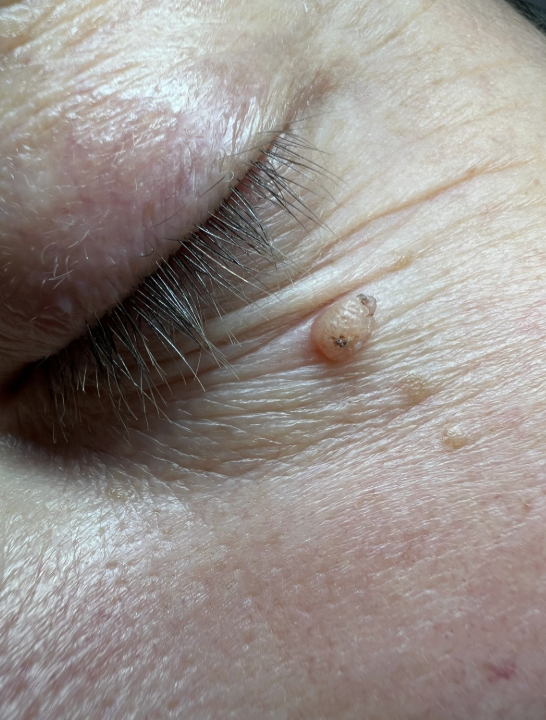
One of the things I find most rewarding about my work is the follow-up appointment. Seeing the skin six to eight weeks after treatment and watching someone’s face when they realise there’s no trace left of something that had been bothering them for years. This case is a perfect example, and I wanted to share it because it also illustrates something important: the difference between a skin tag and a wart, and why that distinction matters before any treatment.
The consultation — “I think it’s a skin tag”
This gentleman came to my Colchester clinic after noticing a growth beneath his eye. He’d had it for some time and had assumed, quite reasonably, that it was a skin tag. Skin tags around the face are very common, and at a glance the two can look remarkably similar; both are small, flesh-coloured, and sit slightly proud of the surrounding skin.
But on close inspection, it was immediately clear this was a wart, not a skin tag. Warts have a slightly rougher, cauliflower-like surface texture up close, and they tend to feel a little firmer than the soft, smooth stalk of a skin tag. They’re also caused by something entirely different: the human papillomavirus (HPV), rather than simple friction and skin-fold irritation.
That is exactly why I do a thorough visual assessment before touching anything. Had he tried to remove this at home, which is tempting and very common, he’d have been treating the wrong thing entirely, with methods that don’t work on warts and that carry real risks around such a delicate area. You can read more about the risks of at-home removal in my blog on DIY skin tag removal, and if you’re not sure what you’re looking at, my guide to skin tags explains the differences in more detail.
Why warts are particularly common around the eye area
The skin around the eyes, known as the periocular area, is some of the thinnest and most delicate on the face, and it’s also an area where people frequently touch without thinking: rubbing tired eyes, removing makeup, applying skincare. HPV spreads through direct contact, so this regular touching makes the eye area one of the most common sites for facial warts to develop.
They’re nothing to be embarrassed about; they’re simply a viral response anyone can develop, but they do need precise treatment, particularly in this location. Because it’s so close to the eye, treatment needs to be controlled and accurate, which is why advanced diathermy in experienced hands is the right approach.
The treatment
Once I confirmed what we were dealing with, I treated the wart in the same appointment using advanced diathermy. This involves a fine electrical current applied precisely to the wart tissue, destroying it cleanly without affecting the surrounding skin. Around the eye area in particular, diathermy’s precision makes it ideal. It lets me work accurately in a small, sensitive space.
The treatment itself took only a matter of minutes. There’s a heat sensation, and the area around the eye can be a little more sensitive than other sites, but it was very well tolerated.
Before, immediately after & 6 weeks post-treatment
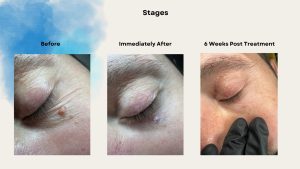
As you can see in the image, there’s some redness and a small amount of swelling immediately after treatment. This is completely normal and expected. The treated area will look a little raw straight after, and a small scab will begin to form over the following 24-48 hours. This is the skin doing exactly what it should: protecting the area while it heals underneath.
Aftercare at this stage is straightforward — keep the area clean and dry, avoid makeup or skincare products directly on the treated site, and resist the urge to pick at any scabbing. The scab is doing an important job and should be left to fall away in its own time.
Six weeks on, the skin is completely clear. No trace of the wart, no scarring, no marking, just smooth, healthy skin. For this gentleman, something he’d been self-conscious about for a long time was simply gone.
Results like this are why I always say: don’t wait. Whether you’ve been putting it off, unsure whether something is worth treating, or wondering whether it’ll go away on its own. Warts rarely resolve without treatment, and the sooner you deal with them, the simpler the process tends to be.
Not sure whether what you have is a skin tag or a wart?
You don’t need to work it out yourself. That’s exactly what a consultation is for. I’ll take a proper look, tell you what we’re dealing with, and we can usually treat it in the same visit if you’re ready to go ahead. I see clients for skin tag removal and wart removal at both my Colchester and Chelmsford clinics, and I also offer a dedicated blemish assessment if you are concerned about a blemish or mole and would like it checked with dermatology.
Feel free to get in touch if you have any questions before booking.
To book your consultation in either my Colchester or Chelmsford Clinic CLICK HERE