
Everything You Need to Know About Removal
If you’ve noticed small, soft growths or tiny finger-like protrusions appearing around your neck, you’re far from alone. Skin tags and filiform warts are two of the most common benign skin conditions I see in my clinic, and they often appear together, particularly in the neck area. The good news is they are completely treatable, and with the right approach, we can remove them safely and effectively with beautiful, lasting results.
What Are Skin Tags?
Skin tags are small, soft, flesh-coloured or slightly darker growths that hang off the skin on a thin stalk. They’re composed of loose collagen fibres and blood vessels, surrounded by skin. They’re entirely benign and pose no health risk, but they can be bothersome, catching on jewellery, clothing, and can affect confidence.
What Are Filiform Warts?
Filiform warts are a specific type of wart caused by the Human Papillomavirus (HPV). Unlike common warts, they grow in distinctive thread-like or finger-like projections, and are typically skin-coloured or slightly darker. They tend to appear on the face, neck, and around the eyes and lips, and can spread if left untreated.
Why Do We Get Them?
Skin Tags
Skin tags are largely caused by friction and skin rubbing against skin, which is why the neck is a common site, particularly where collars, necklaces, or clothing repeatedly make contact. Other contributing factors include:
- Hormonal changes — particularly during pregnancy or as oestrogen and progesterone levels fluctuate
- Weight gain — increased skin folds create more areas of friction
- Age — skin tags become more common from middle age onwards as skin loses elasticity
- Insulin resistance and Type 2 diabetes — there is a well-established link between skin tags and metabolic changes
- Genetics — a tendency to develop skin tags can run in families
Filiform Warts
Filiform warts are caused by certain HPV strains. The virus enters through tiny cuts or breaks in the skin and causes rapid, abnormal cell growth. They can spread through:
- Direct skin contact – with an infected person
- Self-inoculation – touching a wart and then touching another area of skin
- Sharing – towels, razors, or other personal items
- Weakened immunity – which makes the body less able to fight off the virus
When skin tags and filiform warts appear together on the neck, as in many of the clients I treat, it creates a mixed picture that benefits enormously from assessment and a structured treatment plan.
The Treatment: Advanced Electrolysis Diathermy with the Sterex SX-T
My treatment of choice for both skin tags and filiform warts is diathermy with the Sterex SX-T machine, one of the most trusted and respected pieces of equipment in advanced electrolysis.
How Does Diathermy Work?
Diathermy works by delivering a precisely controlled, high-frequency alternating current via a fine probe directly into the lesion. This generates heat within the tissue, cauterising the blood supply to skin tags and effectively destroying the viral tissue of filiform warts. The body then naturally sheds the treated lesion during the healing process.
The Sterex SX-T is renowned for its exceptional precision and intensity control, allowing me to tailor the current to the size, depth, and type of each individual lesion. This precision is what makes diathermy so effective and so safe in professional hands.
The Process: Step by Step
Step 1: The Initial Consultation
Every client begins with a thorough initial consultation before any treatment. This is a non-negotiable first step and an essential part of ensuring you receive the safest, most effective care possible.
During your consultation, we will:
- Review your full medical history, including any medications, medical conditions, and relevant lifestyle factors
- Assess the lesions — differentiating between skin tags, filiform warts, and any other skin changes, and ensuring all growths are suitable for diathermy treatment
- Discuss your expectations and goals — including a realistic timeline for results
- Explain the treatment process fully, including potential side effects and the importance of aftercare
- Carry out a mandatory patch test/skin test — a small area of skin will be treated with the diathermy probe to assess your skin’s individual response. This helps me gauge the appropriate intensity setting, identify any sensitivity, and ensure you heal well before committing to a full treatment
The skin test results are reviewed at your first treatment appointment, allowing your skin at least 24–48 hours to respond. Only once I am completely satisfied with your reaction, I will proceed with treatment.
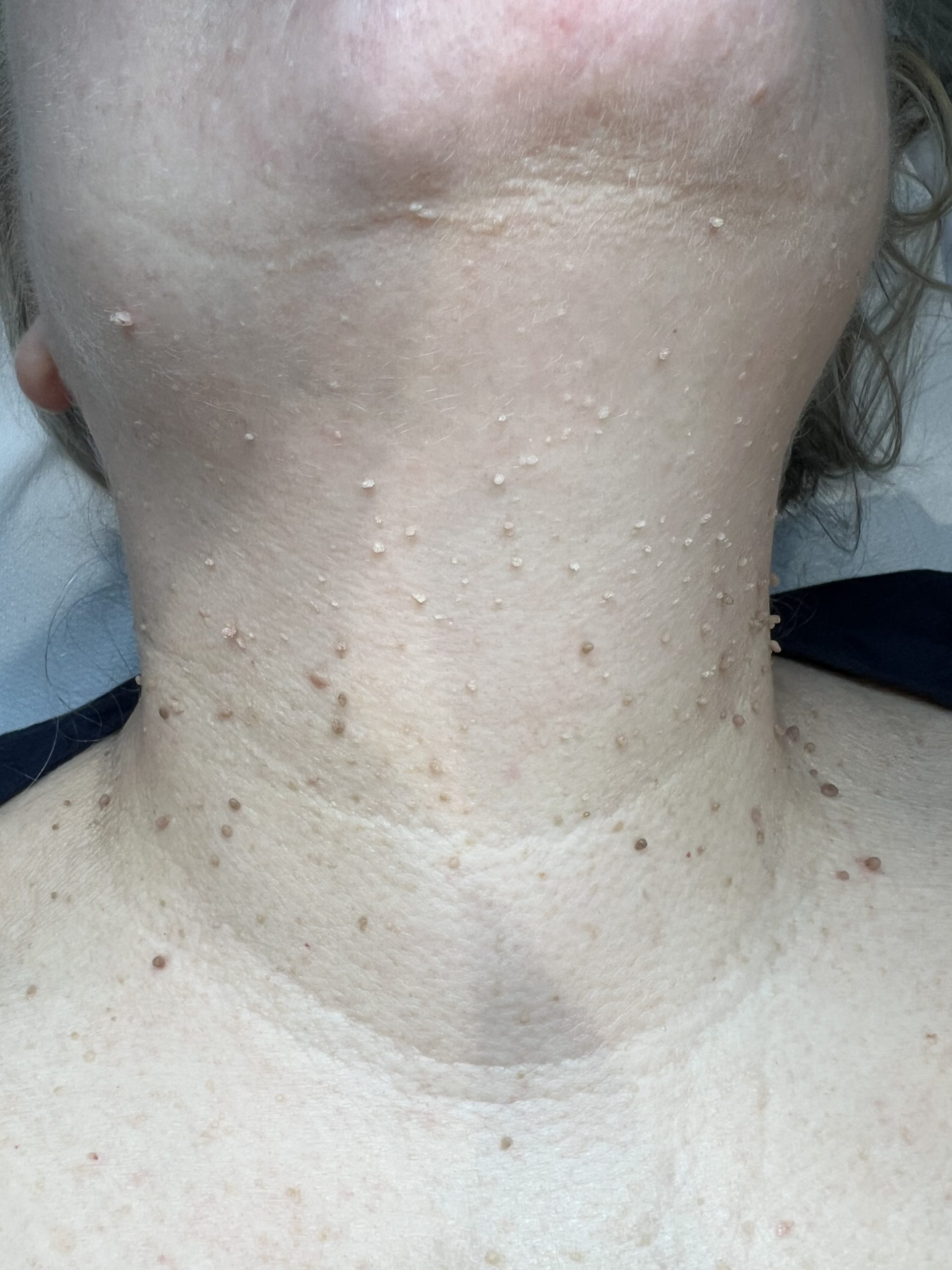
Step 2: The Treatment Programme for my client above — Spread Over 3–4 Sessions
One of the most important principles of my approach is that we never rush through treatment.
When treating a dense cluster of skin tags and filiform warts, as shown in the picture above, it is tempting to remove everything in a single session. However, treating too many lesions at once places a significant burden on the skin’s healing capacity. Over-treatment can lead to prolonged redness, increased risk of scarring, post-inflammatory hyperpigmentation, and a slower overall recovery.
That’s why I structured treatment across 3 to 4 sessions for this client, spaced approximately 2 to 4 weeks apart. This approach:
- Allows the skin’s immune and repair systems to work efficiently between sessions
- Minimises healing time and reduces the risk of complications
- Ensures each treated area is healed before the surrounding skin is worked on
During each session, the probe is applied directly and precisely to each lesion. Treatment is quick; most lesions take just a matter of seconds each, and the sensation is often described as a brief, mild heat or sting. Following treatment, the lesions will appear slightly raised or darkened, and this is completely normal and part of the process as they dry out and begin to fall away naturally.
By the end of these treatment sessions, my client will see a dramatic reduction or often complete clearance of both the skin tags and filiform warts.
Aftercare
Aftercare is just as important as the treatment itself. Following each session, the skin will need gentle, consistent care to heal well and achieve the best possible result. I will give both verbal and written aftercare, along with the aftercare product of choice.
Frequently Asked Questions
Is diathermy painful? Most clients find the sensation very manageable, a brief, sharp warmth at each point.
How long before I see results? Treated lesions will begin to dry and fall away within 1–2 weeks of each session. You will notice progressive improvement after each treatment, with the best results visible 4–6 weeks after your final session.
Can skin tags and filiform warts come back? Skin tags can redevelop over time, particularly if the underlying causes (friction, weight, hormonal factors) remain. Filiform warts may recur if the HPV virus persists in the body, though a healthy immune system and good hygiene significantly reduce the risk.
To book your consultation in either my Colchester or Chelmsford Clinic CLICK HERE